






In This Article
- What climate whiplash actually is and why it is different from ordinary bad weather
- Why swinging between extremes is more destructive than any single disaster
- How insurance collapse, food price inflation, and supply chain chaos connect back to the same cause
- Why whiplash may be more economically damaging than steady, gradual warming
- What the shift from a growth economy to a maintenance economy means for ordinary people
There is an old joke about weather in the American Midwest: if you do not like it, wait five minutes. It used to be a joke. Climate whiplash has turned it into something closer to a warning. The term refers to rapid, violent swings between opposite weather extremes — drought to flood, record heat to sudden freeze, wildfire season to mudslide season — often within the same region and within the same year. Scientists have been tracking this pattern for years. Economists are only now beginning to tally the bill, and the number is not one anyone is going to frame on the wall.
What Climate Whiplash Actually Is
To understand climate whiplash, you have to let go of the idea that climate change means the thermometer simply drifts upward like a slow fever. That picture is too tidy. What is actually happening is more like someone with a shaky hand on the climate thermostat, cranking it up, then down, then up again, and doing it faster every decade.
A warmer atmosphere holds roughly seven percent more water vapor for every one degree Celsius of warming. That sounds like a meteorology footnote until you realize what it means in practice. When conditions are dry, heat pulls more moisture out of the soil and vegetation than ever before, making droughts deeper and faster. When conditions are wet, the sky has more water loaded into it than at any point in recorded history, making rainfall events more intense and more damaging. The result is not a shift toward wet or dry. It is a larger, faster oscillation between both extremes.
California lives this pattern now. Years of punishing drought, the kind that turns reservoirs into mud flats and kills trees by the millions, followed by atmospheric rivers that dump a season's worth of rain in a week, washing out roads and triggering landslides on hillsides that have no roots left to hold them. Australia ran the same playbook during the Millennium Drought and the flooding years that followed. Europe has watched heat waves give way to catastrophic floods in the same summer. Canada has seen wildfire smoke followed by the kind of rain that turns burned hillsides into rivers of ash and debris. This is not a regional quirk. It is a global pattern.
Why Whiplash Hits Harder Than One Big Disaster
Here is the thing about a single catastrophe. It is terrible, but civilizations have always rebuilt after singular terrible things. A flood every fifty years is a tragedy with a recovery arc. Communities bury their dead, take the insurance money, rebuild the bridge, and get on with it. The economy absorbs the hit because it has time to absorb it.
Climate whiplash removes the recovery arc. Drought destroys the crops. Months later, floods destroy the roads that were supposed to carry the next year's harvest to market. Then a wildfire burns through the watershed. Then the rains return and push the burned hillsides down onto whatever was rebuilt in the valley. There is no fifty-year gap between disasters anymore. There is barely a season.
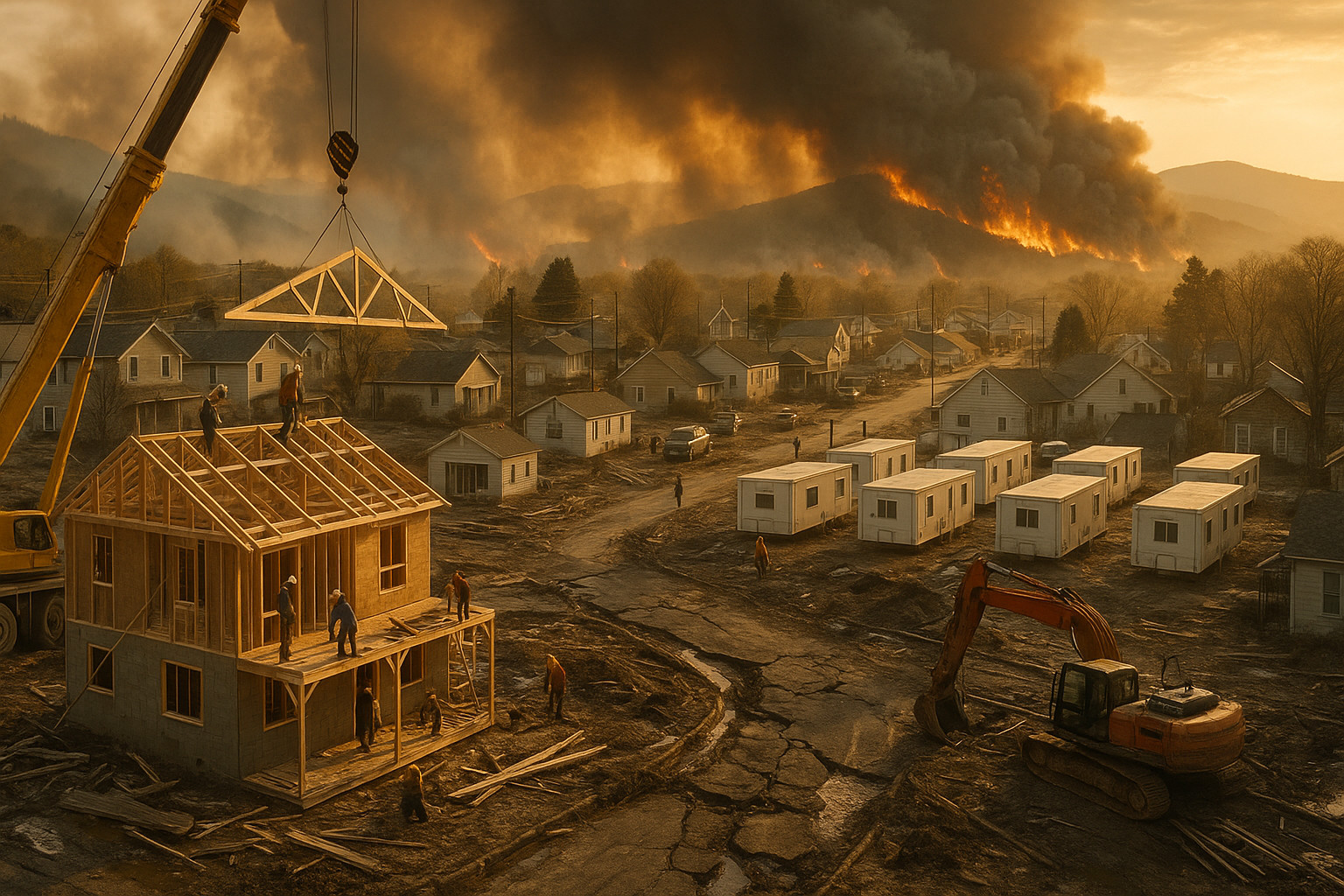
When capital cannot be rebuilt before the next blow arrives, you stop accumulating wealth and start running a very expensive treadmill. The economy looks busy — cranes moving, contracts signed, workers on overtime — but much of that activity is just replacing what existed before the last disaster rather than creating anything new. Aw shucks, you might say, at least people are working. Sure. So are the people bailing out a sinking boat.
How Insurance Becomes the First Domino to Fall
Insurance is the quiet infrastructure that holds the visible economy together. Most people do not think about it until they need it, which is precisely when they discover that it has quietly left the building.
The insurance business is built on one foundational assumption: risk can be predicted well enough to be priced. Actuarial tables, historical data, probability models. Underwriters look at a hundred years of flood records and price a policy accordingly. Climate whiplash breaks that model because the historical record no longer predicts the future. When disasters become more frequent, more severe, and increasingly difficult to model, insurers do the rational thing from their perspective. They raise premiums until customers cannot afford coverage, or they exit the market entirely.
This is not a hypothetical. Major insurers have already stopped writing new homeowner policies in parts of California and Florida. When insurance disappears from a region, mortgages become harder to obtain because lenders require coverage. Businesses cannot secure financing. Investment dries up. Property values fall. The tax base shrinks. Municipal services get cut. People with options leave, and the people without options stay behind in a place that is becoming financially uninhabitable before it becomes physically uninhabitable. That cascade starts with a climate model no actuary can make work anymore.
Agriculture and the Tyranny of Timing
Farming is a business that runs on timing so precise it would make a Swiss watchmaker nervous. Planting windows, frost dates, pollination periods, harvest schedules — every step in the agricultural calendar depends on weather behaving in approximately the way it behaved the year before. Climate whiplash treats that calendar like a suggestion.
Consider what combinations are now appearing in the same growing season. Early warmth that tricks trees into blooming, followed by a late frost that kills the blossoms. A dry spring that stresses the crop, followed by excessive rain at exactly the moment the grain cannot absorb more moisture. A heat wave during pollination that reduces yields before the plant even has a chance to fail from anything else. Harvest-time flooding that leaves equipment stuck in fields and grain rotting in the rows.
Agriculture already operates on margins thin enough that a restaurant owner would walk away from them. A few bad years in succession, not catastrophic years necessarily, just bad enough years stacked one on top of another without time to recover financially, and farms that have been in families for generations go under. The land does not disappear. It gets absorbed by someone with enough capital to absorb the losses, which tends to mean further consolidation and less resilience in the overall food system. And then the food prices that result from all this disruption show up in the grocery store, where they look like inflation, because they are.
Supply-Side Inflation That Central Banks Cannot Fix
There is a category of inflation that economists call supply-side, meaning it comes not from too much money chasing goods but from the goods themselves becoming scarcer or more expensive to produce. Central banks can cool demand-side inflation by raising interest rates. Higher borrowing costs slow spending, slow hiring, slow the economy enough to bring prices down. It is a blunt instrument but it works for that particular problem.
It does not work at all when the problem is that the crop failed, the highway washed out, the power grid went down for a week, and the lumber yard burned. Raising interest rates cannot produce more wheat. It cannot rebuild a bridge faster. It cannot unburn a forest. What climate whiplash produces is persistent supply-side inflation across multiple essential categories at the same time: food, energy, building materials, transportation, insurance. Each category has its own disrupted supply chain, its own damaged infrastructure, its own reason why the price is higher than last year and likely higher still next year.
Ordinary people experience this as the cost of living becoming harder to manage despite working the same hours for the same wages. Economists experience it as a policy problem with no clean solution. The mechanism is not mysterious. The climate is repeatedly damaging the physical systems that produce and deliver the things people need, and each repair costs more than the last because the next disruption arrives before the repair is finished.
Government Budgets and the Maintenance Trap
Governments operate on budgets, which means they face the same treadmill problem at a national scale. Every dollar spent on disaster relief, emergency infrastructure repair, wildfire suppression, flood control, and drought assistance is a dollar not spent on a school, a research program, a transportation project, or a public health initiative that might improve long-run productivity.
This trade-off has always existed at the margins. A hurricane here, a drought year there — manageable. What changes under climate whiplash is the frequency and the simultaneity. Multiple regions experiencing multiple types of disasters in the same fiscal year, requiring emergency spending from budgets that were not designed for permanent emergency mode. Federal disaster declarations in the United States have become so routine that the bureaucratic process for issuing them has been streamlined. That is not a sign of improved emergency management. That is a sign of emergency becoming the baseline.
Public debt tends to rise under these conditions, because governments borrow to cover the gap between normal revenue and emergency expenditure. Rising debt means rising interest payments, which further reduces the budget available for productive investment. The economy does not collapse dramatically. It just gets a little smaller relative to what it could have been, a little slower, a little more burdened, year after year, which is its own kind of catastrophe because it happens too gradually to generate the outrage that a single visible disaster would.
From Growth Economy to Maintenance Economy
Healthy economies grow by creating new things. New factories, new technologies, new housing, new knowledge, new infrastructure that makes future production more efficient than past production. That creation of new value is what raises living standards over time. It is also what makes debt manageable, because the economy generating the debt keeps getting larger and more productive.
Climate whiplash begins to redirect an increasing share of national income away from creating new value and toward restoring old value. Rebuilding the road to where it was before the flood. Replacing the orchard that burned. Restoring the power grid to the condition it was in before the storm. This activity shows up in GDP as economic output, and technically it is, but it is the economic equivalent of running hard to stay in place. The statistician counts it as growth. The farmer who rebuilt the same barn twice in four years knows it is not.
Economists have a name for what happens when a large enough share of investment goes toward replacing lost capital rather than adding new capital. They call it capital consumption. When it happens at scale, productivity growth slows, living standards stop improving or begin to decline, private investment becomes more cautious because the expected returns keep getting interrupted by climate-related losses, and the people with the most mobility begin moving to places that seem more stable. That migration itself accelerates the decline of the regions being left behind, shrinking their tax bases and their political influence at exactly the moment they need more of both.
The most honest way to say it is this: climate whiplash does not just make individual disasters worse. It changes what kind of economy is possible. Not with a bang. Just with a slow, relentless, expensive grind that makes everything harder for everyone except the people selling disaster response services. And they are having a very good decade.
About the Author
 Robert Jennings is the co-publisher of InnerSelf.com, a platform dedicated to empowering individuals and fostering a more connected, equitable world. A veteran of the U.S. Marine Corps and the U.S. Army, Robert draws on diverse life experience, from real estate and construction to building InnerSelf.com with his wife, Marie T. Russell, bringing a practical, grounded perspective to life's challenges. InnerSelf grew from InnerSelf Magazine, founded by Marie T. Russell in 1985, which became InnerSelf.com in 1996. Decades later, InnerSelf continues to inspire clarity and empowerment.
This article is licensed under a Creative Commons Attribution-NonCommercial-NoDerivatives 4.0 License. You may share it with attribution to Robert Jennings, InnerSelf.com, and a link back to the original article at InnerSelf.com. Commercial use and derivative works are not permitted without permission.
Recommended Books
The New Climate Economy by Nicholas Stern — A rigorous examination of how climate change reshapes economic growth and why acting early is far cheaper than rebuilding repeatedly after catastrophe.
A Field Guide to Climate Anxiety by Sarah Jaquette Ray — A practical and compassionate guide for understanding the psychological and economic toll of living inside escalating environmental instability.
Article Recap
Climate whiplash economic damage is compounding because rapid swings between weather extremes prevent the recovery that follows any single disaster, turning regional economies into expensive repair loops rather than wealth-building systems. The long-term economic impact of climate whiplash on agriculture, insurance markets, government budgets, and supply chains may prove more destructive than any individual extreme weather event precisely because it is too frequent and too varied for existing infrastructure and financial systems to absorb. Understanding how climate variability drives supply-side inflation and capital consumption is essential for anyone trying to make sense of why the cost of ordinary life keeps rising even when traditional economic indicators suggest stability.
#ClimateWhiplash #ClimateChangeEconomics #ExtremeWeather #SupplySideInflation #ClimateDisasters #EconomicResilience #ClimateVariability #FloodAndDrought #ClimateCrisis #WeatherExtremes